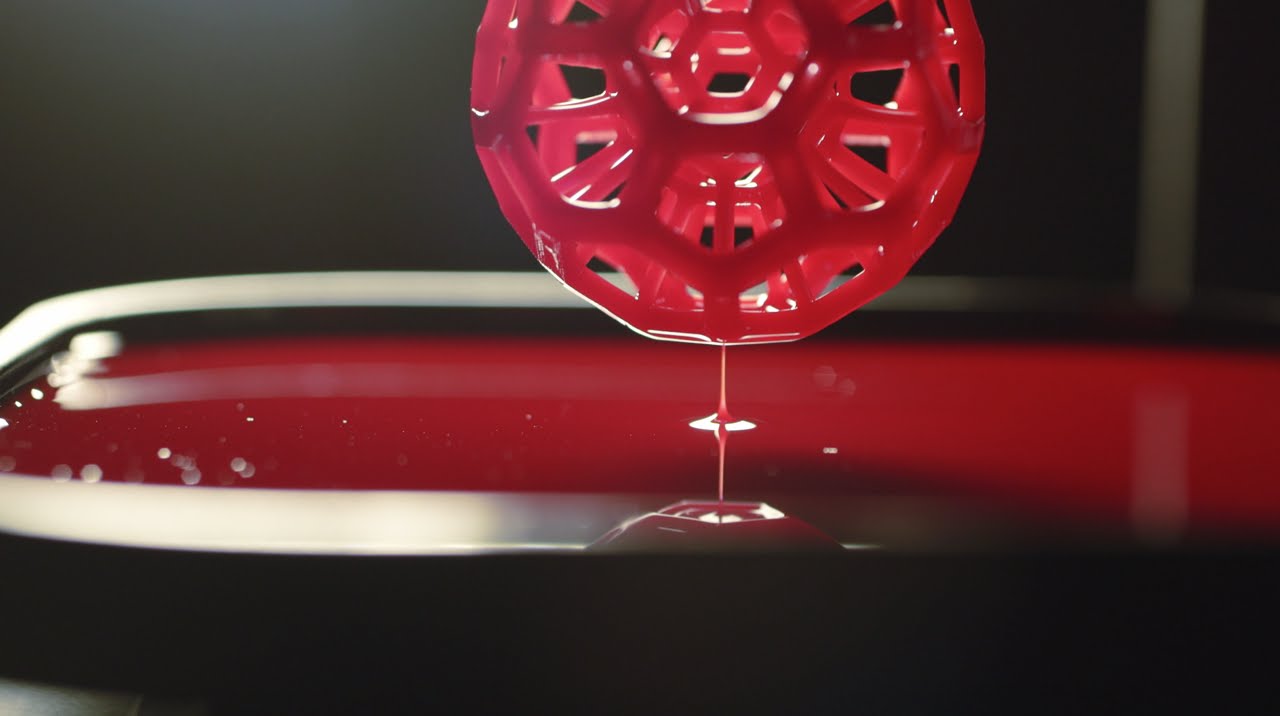
Faster resin printers are a hotspot for venture capital right now. The primary stumbling block in this technology is the layer separation mechanism. These printers all pull a model out of a vat of resin "Terminator" style, using an upside down build platform and a light source beneath the bottom of the transparent resin vat. What this means is that, after curing a layer, the build platform lifts one layer height and the next layer is cured. The problem is, after curing, the resin is liable to be bonded to the bottom of the vat, preventing the platform from being able to pull away from the vat. carbon Solutions are either mechanical or material.  

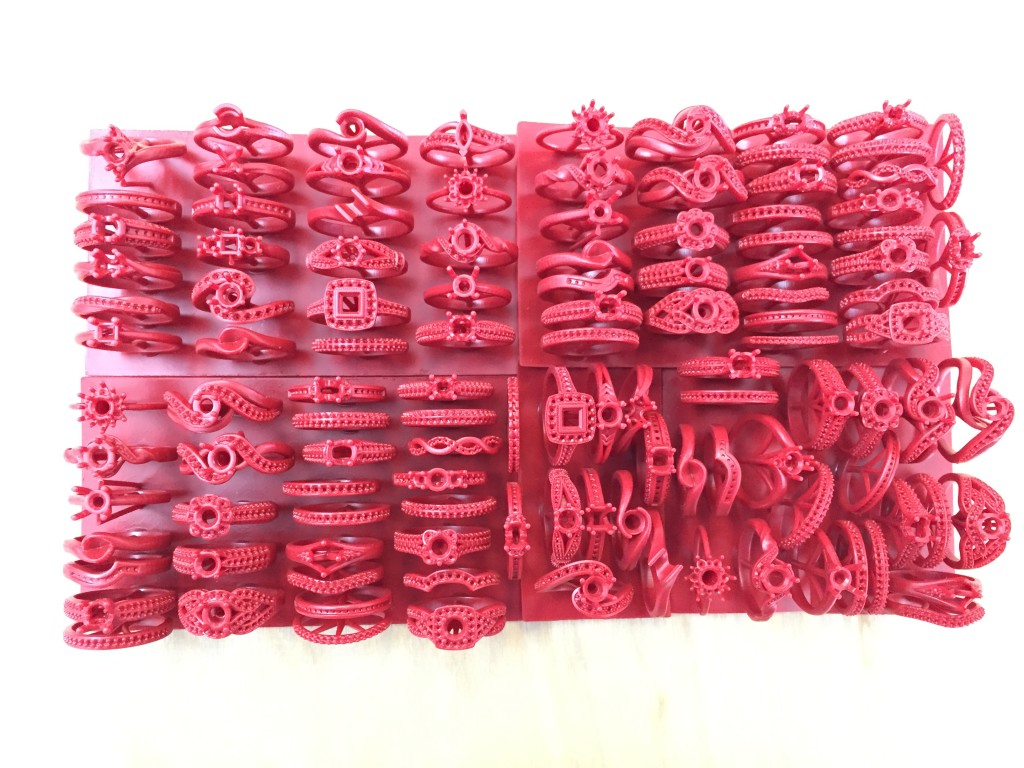
Fast, and unsurpassed for high resolution detail, accuracy, and surface finish, SLA and DLP based resin printing is proven technology that has taken a solid foothold in the prosumer 3D printing market. There are fewer entries here than the overladen FFF/FDM field for several reasons, but it can still be difficult to separate the wheat from the chaff. I've been considering the upgrade to resin printing for several years because of its particular suitability to jewelry production. Build volumes can be somewhat limited because of focusing limitations with the relative resin-curing light sources (laser for SLA and digital image projector for DLP), but that doesn't affect most jewelry applications. Castable resins are available to allow printing "wax" for lost wax casting. DLP allows curing an entire layer at once, relative to the slower process of tracing a line with a laser, so it lends itself to printing trays full of densely packed small parts. [caption id="attachment_2625" align="aligncenter" width="1280"]FernandoCortez_B9C By Fernando Cortez, via B9Creator[/caption] Promises abound in the 3D  printing world, but delivery is another thing. With extrusion based FFF/FDM printing, the market has years of industrial and open source development to build upon. Resin printing has only more recently broken loose into the wild. There are open source projects you can follow here, but there are fewer examples, and a smaller community. There are also larger problems to solve and the whole thing costs more than building your own filament printer. For this reason, I would highly recommend choosing an established and proven performer, like one of the following printers.


I had an excellent reception at Maker Faire with Steadcraft last year and I'm super excited to announce that I'll be returning once again this year! Mark your calendar and come on down to the Maker Faire May 20th-22nd. You'll be glad to know that I'm still...

Sometimes there is no substitute for hands. Ask potter Tortus Copenhagen, who's "Making Gestures" photo series defines handmade.   [gallery type="rectangular" link="none" ids="2533,2534,2536"] says Tortus:
"We believe that value begins with the mastery of making. Throwing vessels on the wheel requires the use of a number of carefully controlled ‘gestures´, each suited to shape and guide the clay in a different manner as it spins on the wheel. Each has is own distinct shape, function, or even design one could say. These gestures, nearly artworks in themselves are perfected to sense and lure the best out of material. Sturdy yet delicate hands, shaped by time and clay, apply the careful yet impulsive pressures that give each piece its own unique character. These are just a few of the gestures we use every day."
I first started working with clay in the early 90's, under the tutelage of Ken Stevens and Reid Ozaki at the University of Puget Sound. I quickly shifted my focus to working with The New Clay, which offered exciting opportunities to work with multiple traditional craft techniques with one simple material and virtually no tools. Thus I launched a career of handcraft, using for many years just my hands, a mayonnaise jar, a tissue blade, and a convection oven.  My tools and techniques have become much more complex over the years. Now I work with virtual clay. I 3D print. I use metal clay. Seeing these photos, I can feel the spinning lump of wet earthen clay,

I can't get over these incredible lifelike sculptures made by combining traditional sculpture techniques with digital modeling and prototyping. Artist Rey Hernandez has published a fascinating expose on his techniques. Peek inside Scientific Art Studio and see how they created the Animal Learning Plaza for the San Francisco Zoo. Envisioned as tactile exhibits, photos give scant clues that the sculptures are not living and breathing. [gallery type="rectangular" link="none" ids="2496,2512"] [gallery type="rectangular" link="none" ids="2497,2498,2499"] It may be that not every home needs a 3D printer, but Rey aptly demonstrates the advantages conferred to artists by digital design. After designing in Zbrush, the models are either 3D printed, or cut from foam on CNC machinery, then cast in bronze, concrete, or resin. Note the intermediary clay model: [gallery type="rectangular" link="none" ids="2514,2517,2508"]

Further evidencing that 3D printing can play a part in a manual craft process rather than simply replacing it, Adam Beane Industries has announced a forthcoming sculptable 3D printing filament. [gallery type="rectangular" size="medium" link="none" ids="2473,2472,2471"] The material hardens at room temperature but becomes sculptable at 125 degrees...

Are you enjoying Autodesk Memento? Now is your chance to give some feedback to the development team via the Stanford Creative Ignition Lab. We would be grateful if you would Take the Survey. What might you do with Memento? I modeled these giant freighters automatically from just 150 photos: